English Horror Stories
The Last Customer at Table Six
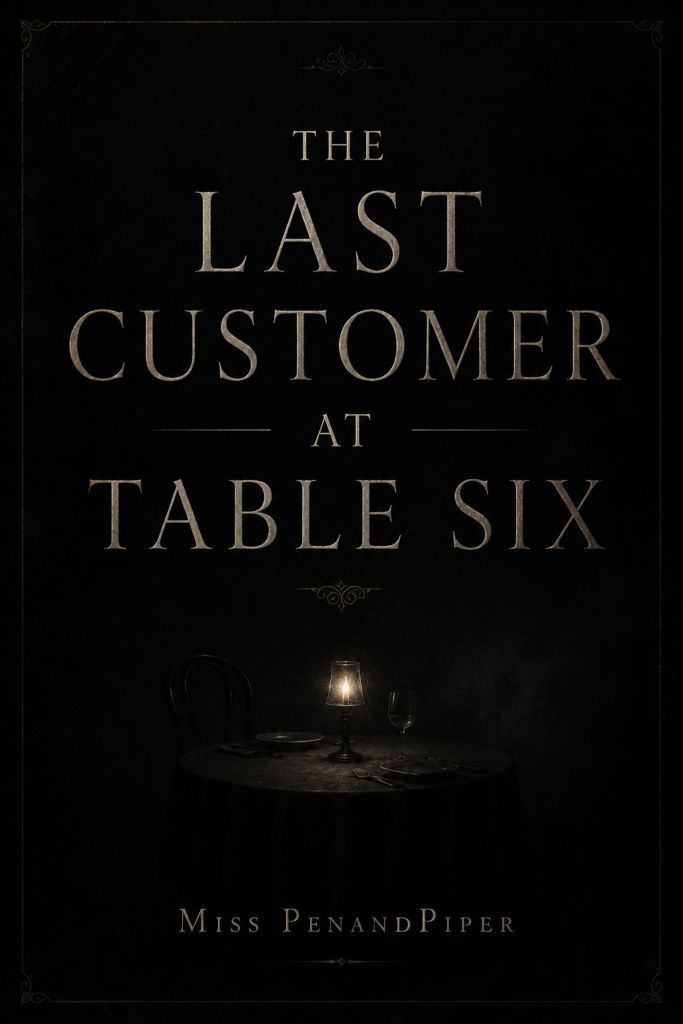
Mercy’s Diner is open twenty-four hours a day.
But after midnight, there is one rule every employee must obey:
Never serve anyone who sits at Table Six.
When Lena Hart takes the night shift, she thinks it is only an old superstition—until a silent man in a dry black coat enters during a storm and asks for coffee.
By morning, one regular customer has vanished from the town’s memory.
And the receipt from Table Six now has Lena’s name on it.
Part One
The Rule After Midnight
The first thing Lena Hart learned about Mercy’s Diner was that Table Six was never to be served after midnight.
It was the only round table by the window.
During the day, there was nothing strange about it. Truck drivers ate breakfast there. Children dropped fries under it. Old women sat there after church and shared slices of pie. The table had scratches, coffee stains, and one uneven leg that made every cup tremble slightly.
But every night at eleven fifty-five, June covered it with a black cloth.
June was the manager of Mercy’s Diner. She was thin, silver-haired, and quiet in a way that made people lower their voices around her. She had worked at the diner for so long that some customers joked she must have been born behind the counter.
On Lena’s first night shift, June took her to Table Six and placed one hand on the back of the nearest chair.
“After midnight,” June said, “no one sits here.”
Lena smiled, thinking it was a joke.
June did not smile back.
“If someone comes in after midnight and chooses this table, do not bring water. Do not bring coffee. Do not hand them a menu. Do not ask what they want.”
“What do I do?”
“You come get me.”
“What if you’re not here?”
June’s fingers tightened around the chair.
“Then you close the kitchen window, stand behind the counter, and say nothing.”
Lena looked at the table.
The lamp above it flickered once.
“That sounds a little dramatic for a diner rule.”
June leaned closer.
“It is not a diner rule. It is a survival rule.”
Lena needed the job badly enough not to laugh again.
She had arrived in Wrenfield with one suitcase, one unpaid phone bill, and no interest in explaining why she had left the city. Mercy’s Diner hired her the same day she asked. The pay was not much, but the room above the kitchen came with it, and for the first time in weeks, Lena had a door she could lock.
So she followed the rule.
Every night, June covered Table Six.
Every night, Lena pretended not to look at it.
And every night, no one sat there.
Until the rain came.
It started before sunset and did not stop. By eleven-thirty, the road outside the diner was black and shining. The windows rattled softly whenever the wind pushed against them. The neon OPEN sign blinked red in the glass.
June went home early that night with a migraine.
Before she left, she paused at the door and looked back at Lena.
“Remember Table Six.”
“I remember.”
June’s eyes stayed on her.
“Remembering is not the same as obeying.”
Then she stepped into the rain and disappeared.
By midnight, the diner was empty except for Lena and Amos, the cook, who was washing pans in the kitchen.
The wall clock ticked toward twelve.
At exactly midnight, the lights flickered.
The front door opened.
A man stepped inside.
He was tall and narrow, wearing a dark coat that should have been soaked from the rain. But not a single drop fell from him. His shoes made no sound on the floor.
Lena stood behind the counter.
“Good evening,” she said automatically.
The man did not answer.
He walked past the counter.
Past the booths.
Past every empty table in the diner.
Then he stopped at Table Six.
Lena’s hand went cold around the coffeepot.
The man pulled out a chair and sat down.
The black cloth in the center of the table shifted, though no wind had entered with him.
The lamp above him flickered again.
From the kitchen, Amos called, “Everything all right?”
Lena did not answer.
The man folded his hands on the table.
“Miss,” he said softly, “may I have coffee?”
Lena remembered June’s warning.
Do not bring water.
Do not bring coffee.
Do not hand them a menu.
Do not ask what they want.
She swallowed.
“I’m sorry,” she said. “The kitchen is closed.”
The man looked at the glowing OPEN sign in the window.
“No,” he said. “It is not.”
Behind Lena, the coffeemaker clicked.
Fresh coffee began to drip, though she had not touched it.
The smell filled the diner.
Warm.
Dark.
Bitter.
The man watched her with patient eyes.
“Just coffee,” he said.
Lena told herself it was only a strange rule. Only an old woman’s superstition. Only a customer on a rainy night asking for something simple.
So she took a clean cup from the shelf.
She filled it.
Then she carried it to Table Six.
The moment she placed the cup before him, the entire diner went silent.
No hum from the lights.
No hiss from the grill.
No sound from the rain.
The man wrapped both hands around the cup.
“Thank you,” he said.
Behind Lena, the cash register opened by itself.
A receipt began to print.
Lena backed away from the table and tore the paper from the machine.
There was no price.
No order number.
Only three words printed in faded black ink.
ONE MEMORY PAID
Then, from the kitchen, Amos screamed.
Part Two
The Man Everyone Forgot
When Lena reached the kitchen, Amos was standing by the freezer with his hands pressed against his head.
“What happened?” Lena asked.
Amos looked at her as if he did not fully recognize her.
“There was someone,” he whispered.
“Yes. The man at Table Six.”
Amos stared past her into the dining room.
“What man?”
Lena turned.
Table Six was empty.
The cup of coffee sat untouched in the center of the table. The black cloth had been folded neatly beside it. The chair had been pushed back into place.
“He was just there,” Lena said.
Amos shook his head. “No one came in.”
“You heard him.”
“I heard the door.”
“You called out to me.”
“I heard the door,” Amos repeated. His voice trembled. “Then I forgot something.”
Lena gripped the receipt.
“What did you forget?”
Amos looked at his hands.
“I don’t know. That’s the worst part.”
June returned to the diner twenty minutes later wearing a coat over her nightgown. Her hair was pinned badly, and her slippers did not match.
Lena handed her the receipt.
June read it once.
Then she closed her eyes.
“You served him.”
“He only asked for coffee.”
“He never asks for what he really wants.”
“Then tell me what he wants.”
June folded the receipt and placed it in her pocket.
“A payment.”
The next morning, Mr. Kline did not come in for breakfast.
At first, that meant nothing. People missed breakfast. People slept late. People changed routines.
But Arthur Kline never missed breakfast.
Every morning at seven, he sat at the counter, ordered two eggs, dry toast, and black coffee, then wrote in his brown leather notebook until his plate was empty.
That morning, his stool stayed empty.
Lena noticed it immediately.
“Where’s Mr. Kline?” she asked.
The customer at the counter frowned. “Who?”
“The man who sits there every morning.”
The customer gave a small laugh. “I’ve been eating here for twenty years. No one sits there every morning.”
Lena looked at Amos.
His face went pale.
June stopped pouring coffee.
By noon, Arthur Kline had disappeared from the town’s memory.
His small blue house at the end of Maple Street was empty. His mailbox had no name. The pharmacist did not remember filling his prescriptions. The librarian did not remember setting aside travel books for him. The barber did not remember cutting his hair every other Thursday.
Only three people remembered him.
Lena.
Amos.
June.
That afternoon, Lena found Arthur Kline’s brown leather notebook under the counter.
Every page was blank except the last.
Written there in careful handwriting was one sentence:
I lived longer than I was meant to.
Lena brought the notebook to June.
The manager was sitting in the back office with an old ledger open on her desk.
“How many?” Lena asked.
June closed the ledger too quickly.
“How many people has Table Six taken?”
June did not answer.
Lena stepped closer.
“You knew this would happen.”
“I knew the rule.”
“That is not an answer.”
June looked older than she had the night before.
“There are places,” she said quietly, “where the world is thin. Crossroads. Bridges. hospital rooms. Roads during storms. Diners open after midnight.”
Lena said nothing.
“Mercy’s was built at the end of the old highway,” June continued. “Years ago, people came here when they had nowhere else to go. Some were lost. Some were hurt. Some were already supposed to be gone.”
“And the diner saved them?”
“For a while.”
Lena looked toward the dining room.
“At what cost?”
June’s eyes shifted to Table Six.
“Borrowed time always leaves a balance.”
Lena understood slowly.
“Mr. Kline?”
“Bus accident,” June said. “1987. He should have died with the others when the bus went off the bridge. Instead, he found Mercy’s Diner in the rain. Mercy gave him coffee. He lived almost forty more years.”
“And last night, the man came to collect.”
June nodded.
“The last customer comes for those who have unpaid time.”
Lena held up the receipt.
“Then why does this say one memory?”
“Because the diner does not take people all at once,” June said. “It takes their place first. Their chair. Their cup. Their name in someone else’s mouth. Then, piece by piece, the world forgets they were ever here.”
Lena felt sick.
“Why keep the diner open?”
June’s face hardened, but her eyes looked afraid.
“Because closing it does not close the debt.”
That night, Lena packed her bag.
She had no intention of staying in a town where a diner could erase a man from the world.
But when she opened the door of her room above the kitchen, June was waiting in the hallway.
“You cannot leave yet,” June said.
Lena tightened her grip on the bag.
“Watch me.”
June held out the receipt from the night before.
The ink had changed.
The words ONE MEMORY PAID were gone.
A new line had appeared.
SERVER RESPONSIBLE FOR BALANCE
Lena stared at it.
“What does that mean?”
June’s voice was barely above a whisper.
“It means he will come back.”
“When?”
Downstairs, the old wall clock began to tick.
Though it had not worked in years.
June looked toward the stairs.
“Tonight.”
Part Three
The First Debt
Lena spent the rest of the day reading the ledger.
June did not stop her.
Maybe she was too tired.
Maybe she had waited too long for someone else to know.
The ledger was thick, heavy, and stained at the corners with coffee rings. Each page listed names, dates, orders, and balances.
The first entry was from 1949.
June 3, 1949
Mercy Vale
Order: coffee
Balance: the diner will remember what the world refuses to keep
Lena read the line twice.
“What does that mean?”
June stood in the office doorway.
“It means Mercy made the first bargain.”
“Who was Mercy?”
“The woman who opened this place.”
Lena looked down at the ledger.
June continued.
“There was a storm that night. The old road flooded. Three families were trapped. A bus turned over near the bridge. People came here freezing, bleeding, begging for help. Mercy served anyone who reached the door.”
“And they lived?”
“Some did. Some should not have.”
Lena turned the page.
The entries continued.
Spared from fever.
Spared from fire.
Spared from drowning.
Spared from the bridge.
Every person had been given more time.
Every person had a balance.
“And Table Six?” Lena asked.
June looked toward the dining room.
“That was Mercy’s table. She sat there until sunrise, writing names so no one would be forgotten.”
“What happened to her?”
June did not answer quickly.
Then she said, “The diner kept her too.”
Lena flipped toward the newer entries.
She found Arthur Kline’s name near the end.
Arthur Kline
Spared from bus accident, 1987
Balance collected
Below it, in fresh ink, was another line.
Server: Lena Hart
Balance pending
Lena pushed the ledger away.
“I didn’t borrow time.”
“No,” June said. “But you opened the table.”
“I served coffee.”
“You completed the order.”
Lena stared at her. “That makes me responsible?”
“That makes the diner able to choose you if another balance is not paid.”
The words settled between them.
Then Lena saw a name on the final unpaid page.
June Alder
Spared from house fire, 1968
Balance unpaid
She looked up slowly.
June did not move.
“You?” Lena whispered.
June’s mouth trembled.
“I was seven,” she said. “My parents died in the fire. I crawled through smoke until I saw a light. I thought it was morning, but it was Mercy’s Diner. Mercy gave me milk in a blue cup.”
“You have been unpaid this whole time?”
June nodded.
“Why didn’t he take you?”
June reached into her apron pocket and removed a small stack of old receipts.
Each one had a different name printed on it.
Lena understood.
“You gave him other people.”
June closed her eyes.
“I followed the ledger.”
“No,” Lena said. “You hid behind it.”
June’s voice cracked.
“I was afraid.”
The diner lights flickered.
The wall clock struck midnight.
The front door opened.
The last customer stepped inside.
He wore the same dark coat, the same polished shoes, the same face that seemed impossible to remember clearly.
This time, he looked directly at June.
“Good evening,” he said.
June did not answer.
He walked to Table Six and sat down.
The black cloth folded itself neatly. The sugar bowl uncovered itself. The saltshaker turned upright.
The man looked at Lena.
“Miss Hart,” he said softly. “May I have the menu?”
June grabbed Lena’s wrist.
“Do not.”
Lena looked at the last customer.
“What happens if I refuse?”
The man smiled faintly.
“Then the diner chooses.”
The cash register opened.
A receipt began to print.
Lena did not move.
The paper curled slowly toward the floor.
June picked it up with shaking hands.
When she read it, her face drained of color.
Lena took the receipt.
One name had been printed at the bottom.
LENA HART
The diner had chosen her.
The last customer folded his hands on the table.
“The balance must be paid.”
Lena looked at the ledger.
At June.
At Table Six.
Then she walked into the office and tore out the very first page.
The page with Mercy Vale’s name.
The page that began the bargain.
June gasped. “Lena, no.”
Lena took a clean white plate from the kitchen. She placed the ledger page on it, carried it to Table Six, and set it in front of the last customer.
He stared down at it.
“What is this?” he asked.
Lena’s voice did not shake.
“Your order.”
Part Four
Balance Closed
The diner went silent.
The coffeemaker stopped.
The rain froze against the window, each drop suspended on the glass as if time itself had paused to listen.
The last customer looked at the ledger page on the plate.
The ink began to move.
Letters twisted.
Lines shifted.
The first entry changed before Lena’s eyes.
Mercy Vale
Order: coffee
Balance: Mercy’s Diner
June covered her mouth.
“No one has ever done that,” she whispered.
Lena kept her eyes on the last customer.
“You said the balance must be paid.”
The man’s expression changed.
For the first time, he looked less like a customer and more like something old that had been caught using the wrong door.
“This is not your debt,” he said.
“No,” Lena replied. “But the diner tried to make it mine.”
The wall lamp above Table Six flickered violently.
The floor groaned.
From the kitchen came the sound of plates rattling in their stacks.
Lena pointed to the ledger page.
“The diner has been collecting from everyone else for years. Names. Memories. Places in the world. But Mercy’s Diner was the first balance.”
June stepped forward.
“If he takes the diner,” she said, “everyone it held may be remembered.”
“Good,” Lena said.
June shook her head. “Remembering hurts.”
“So does being erased.”
The last customer turned to June.
“You were due many years ago.”
June nodded slowly.
“I know.”
“Are you ready?”
June looked around Mercy’s Diner.
At the counter she had wiped for most of her life.
At the stools where forgotten people had once sat.
At Table Six, where fear had made her silent.
Then she removed her apron.
Folded it.
And placed it on the table.
“Yes,” she said. “But not in her place.”
The lights went out.
Only Table Six remained lit.
The last customer stood and lifted the plate with the ledger page.
The window beside him turned black.
Then the blackness opened.
Outside, the road was gone.
In its place stretched a long, narrow platform covered in mist. At the far end stood dozens of figures. Some carried suitcases. Some held umbrellas. Some wore hospital gowns. Some looked young. Some looked old. All of them looked as if they had been waiting for someone to remember their names.
Lena recognized one of them.
Arthur Kline.
He stood near the front, holding his brown leather notebook.
For a moment, his tired face became clear.
Then he smiled at her.
June began to cry.
“Arthur,” she whispered.
The last customer looked at Lena.
“Step away from the table.”
Lena obeyed.
The ledger page lifted from the plate and caught fire without flame. It glowed white, then gold, then disappeared into ash.
Mercy’s Diner shook.
Every name in the ledger rose from the pages in thin black ribbons of ink. They circled the room, then flew toward the window and vanished into the mist.
Outside, the waiting figures began to fade.
Not suddenly.
Not violently.
Peacefully.
As if they had finally been allowed to leave a room where they had stood for too long.
June stepped toward the window.
Lena reached for her. “June.”
The old woman looked back.
For the first time since Lena had met her, June looked young in the eyes.
“I was only seven,” June said softly.
“I know.”
“I should have gone then.”
Lena did not know how to answer.
June smiled sadly.
“Thank you for serving the right thing.”
Then she walked into the mist.
The last customer followed.
Before he disappeared, he placed one final receipt on Table Six.
The window went dark.
The lights returned.
Lena stood alone in the diner.
No rain.
No mist.
No June.
No last customer.
The receipt sat in the center of Table Six.
With shaking hands, Lena picked it up.
There was no warning.
No name.
Only two words.
BALANCE CLOSED
By morning, Mercy’s Diner was gone.
Not burned.
Not abandoned.
Gone.
The building had vanished from the side of the road, leaving only a square patch of dry earth where it had stood.
The town remembered slowly.
People woke with names on their tongues and grief in their chests. They remembered neighbors, friends, grandparents, and children they had somehow forgotten. Old photographs changed. Empty chairs gained meaning again. Mailboxes bore names that had been missing for years.
Arthur Kline’s blue house returned to Maple Street.
Empty, but real.
His mailbox had his name again.
At the cemetery, June Alder’s stone appeared beside the stones of her parents.
The date of her death was not the night she walked into the mist.
It was the night of the fire in 1968.
Lena left Wrenfield two days later.
She took only her suitcase, Arthur Kline’s notebook, and the final receipt from Table Six.
For months, she avoided diners.
She drank coffee from paper cups. She ate meals in bright places with no table numbers. She never sat near windows after dark.
Then one winter evening, on a long road far from Wrenfield, her car broke down near a town she had never visited.
The only open place was a diner at the edge of the highway.
Its sign glowed weakly through the rain.
Lena stood outside for a long time before stepping in.
A young waitress behind the counter looked up.
“Sit anywhere,” the girl said.
Lena’s eyes moved across the room.
Booths.
Counter stools.
Small square tables.
Then she saw it.
A round wooden table by the window.
Old.
Empty.
Waiting.
A black cloth lay folded in the center.
The waitress noticed where she was looking.
“Oh,” the girl said, lowering her voice. “Not that one.”
Lena turned slowly.
“Why?”
The girl gave an awkward little laugh.
“I know it sounds strange,” she said. “But the manager says we’re not supposed to serve Table Six after midnight.”
Behind the counter, the old wall clock began to tick.
Lena looked at the table.
Then at the young waitress.
This time, before the hour could turn, Lena set her suitcase down and said,
“Tell me everything.”
And until sunrise, no one served Table Six.
-END-